
Why Valais Is Better Than Finale Ligure
An entirely biased love letter to bigger mountains, quieter trails, and better sunlight

There, I said it.
Finale Ligure is great. Iconic, even. It has earned its place in mountain bike mythology: dusty switchbacks, olive groves, post-ride focaccia, sea views, and enough enduro history to fill a museum gift shop. If you ride bikes and you’ve never been to Finale, chances are it’s on your list, somewhere between “trip I actually booked” and “trip I talk about every winter.”
But as much as people love talking about Finale like it’s the promised land of mountain biking, I’m going to commit a mild act of heresy here:
The Swiss Valais is better.
Not in every single way, for every single rider, every single day of the year. That would be too easy, too tribal, too internet-comment-section. But if we’re talking about the kind of riding that leaves you grinning like an idiot for three days, scenery that makes your photos look fake, and trail networks that still feel like you discovered them yourself, then yes — Valais comes out on top.
And once you’ve spent enough time in both places, it becomes harder and harder to pretend otherwise.
Finale Ligure: the classic everyone knows
Let’s start with respect where respect is due.
Finale Ligure is good. Really good. It’s accessible, it has loads of trails, the food is fantastic, and the whole “ride in the mountains, finish at the sea” formula is undeniably seductive. It’s social, easy to understand, and very good at making you feel like you’re in the middle of mountain bike culture. There’s a reason people keep going back.
It’s also familiar.
And that’s both its strength and its weakness.
Finale has become one of those places where the reputation arrives before you do. You already know the names of the trails, you’ve seen the same berms in twenty edits, and by the time you roll into town, it can feel like you’re stepping into a riding destination that has been fully packaged, sorted, hashtagged and consumed. Great fun? Sure. Wild and unforgettable? Sometimes. But increasingly, it can feel a little bit like mountain biking inside a greatest-hits playlist.
Valais, by comparison, still has edges.
It still has space.
It still has that feeling that the mountains are vastly bigger than your ride plan, and that what you’re about to do is only a tiny sample of what’s out there.
That matters.
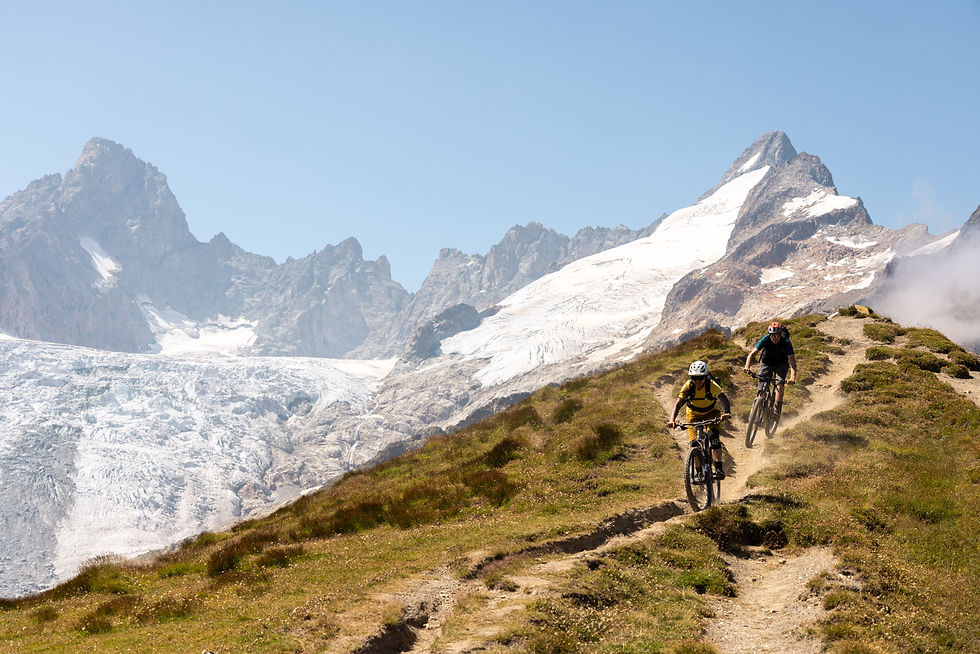
The mountains in Valais are simply on another scale
This is probably the most obvious difference, and also the hardest to ignore once you’ve experienced it.
Finale has hills. Valais has mountains.
Proper ones.
The kind that dominate the horizon, distort your sense of distance, and make your ride feel like a small adventure even before the wheels start turning. In Finale, the backdrop is beautiful in a soft, Mediterranean kind of way. In Valais, the backdrop looks like the Earth decided to show off.
The scale changes everything.
The climbs, the descents, the exposure, the drama, the weather patterns, the sense of journey — it all becomes more intense and more memorable. A trail in Finale can be brilliant fun. A trail in Valais often feels like it belongs in a dream sequence directed by someone with a thing for glaciers, larch forests and huge alpine ridgelines.
There’s also a certain psychological effect that bigger mountains create. You don’t just ride through them; you feel inside them. The whole day has more gravity, more contrast, more reward. Shuttle up high enough in Valais and you’re not just chasing turns — you’re moving through landscapes that feel genuinely grand.
That’s hard to replicate.
And once you’ve had a few days where your descents begin under enormous peaks and finish far below in sun-drenched valleys, it’s quite difficult to get excited about riding somewhere that feels smaller, tamer and more compressed.
The trails feel less used — and that changes everything
This, for me, is where Valais really starts pulling away.
Finale is ridden. A lot. It’s one of the most famous riding zones in Europe, and it feels like it. That doesn’t automatically ruin a place, of course, but it does shape the experience. Popular trails become polished. Braking bumps develop. Corners widen. Lines get obvious. The sense of mystery fades. You’re often not discovering a trail so much as participating in a very well-established flow of riders who have all had the same idea.
Valais still gives you something increasingly rare in modern mountain biking: the sensation that the trails breathe.

They feel more natural, more spacious, and in many places, less hammered into the ground by endless traffic. The terrain feels alive under the bike rather than over-managed for repeat consumption. You can still find descents that feel quiet, rough around the edges, and beautifully underexposed in the social-media sense.
That doesn’t mean Valais lacks quality. Quite the opposite. The trails are outstanding. But many of them still retain character instead of being polished into bike-park-lite uniformity. One trail may be high-speed and open, another technical and old-school, another flowing through forest with just enough unpredictability to keep you honest.
There’s texture to the riding.
And there’s also something emotionally satisfying about not spending your ride day in what feels like Europe’s busiest mountain bike queue system.
Not every rider wants that. Some people love the energy of a famous hotspot. But if your ideal day includes fewer people, more mountain, and the occasional moment where you stop and think, How is this place not completely overrun? — then Valais starts to look very convincing indeed.
Sunshine is not a small detail — it’s half the experience
People underestimate how much weather shapes a riding destination.
Valais has one of the biggest hidden luxuries in European mountain biking: sunshine, and lots of it. Not in a tropical beach-holiday sense, but in that deeply satisfying alpine way where the air feels dry, the views stretch forever, and the whole valley glows from morning into late afternoon.
It changes the mood of everything.
The trails dry faster. The dirt rides better. The shoulder-season days feel more reliable. And psychologically, there’s something about loading bikes in bright sunshine with big peaks all around that just makes a riding day feel richer before it even begins.
Finale, of course, gets plenty of good weather too. But Valais sunshine hits differently. It’s cleaner, crisper, more dramatic. The light has depth. You get this combination of arid valley landscapes, high alpine terrain and ridiculously photogenic skies that makes even a mid-ride snack stop feel cinematic.
You know those ride days where everything seems to line up — hero dirt, clear air, massive views, no nonsense? Valais produces a lot of those.
And while weather alone doesn’t make a destination better, reliable sun combined with altitude, scale and lower trail traffic absolutely does.
Valais feels more like an adventure and less like a product
This is perhaps the least measurable difference, but maybe the most important.
Finale is excellent at being a known quantity. You know roughly what you’re going to get, and there’s comfort in that. Shuttles, cafés, trail names, ride itineraries, beach-town vibe — it’s all there, polished and ready.
Valais still feels a bit more raw in the best possible sense.
Not chaotic. Not inaccessible. Not “you need a survival blanket and a PhD in route-finding.” Just less over-curated. The riding feels embedded in a real alpine landscape rather than arranged around the expectations of visiting riders. Villages feel like villages. Valleys feel lived in. The mountains don’t seem to care whether you’ve come for your annual lads’ trip or a three-day escape from your office job.
That gives the experience more soul.
There’s something deeply refreshing about a place that doesn’t constantly wink at you and say, “Look, this part is for mountain bikers.” In Valais, mountain biking feels woven into a much bigger environment — agriculture, villages, history, transport, climate, altitude, all of it. The ride doesn’t exist in isolation. It belongs to a place.
And that sense of place is powerful.
It’s the difference between visiting a destination and entering a landscape.

The variety is more serious than people think
People who haven’t ridden much in Valais sometimes imagine it as one thing: big alpine descents. Which is a bit like describing Italy as “pasta.”
Technically not wrong. But not exactly useful.
Valais has huge variety. Dry, loose terrain in some areas. Forest singletrack elsewhere. Big traversing rides. Raw natural descents. More flow in some zones, more technical old-school riding in others. Some rides feel almost high-mountain epic; others feel playful and fast. You can link zones, mix elevations, and piece together days that feel distinct rather than repetitive.
That’s one of the quiet advantages of the region: it has depth.
Finale also has variety, but it can begin to blur after a while. The terrain has a certain signature — a fun one, but a recognizable one. In Valais, the riding identity shifts more dramatically depending on where you are and how you build the day.
For riders who like to return to a place and keep finding new character, that matters more than the brochure version of “hundreds of trails.”
“But Finale has the sea…”
Yes. It does.
And that is a strong card.
The sea is lovely. Nobody is denying the romance of finishing a ride and eating seafood near the water. If your ideal post-ride scene involves palm trees, a beer on the promenade, and a warm coastal evening, Finale remains very hard to beat.
But here’s the counterpoint:
The sea is not actually part of the ride.
The mountain is.
And if the argument is about which destination offers the better mountain biking experience, I’m still taking Valais. Every time. Because while the sea is a beautiful extra, Valais gives you more of the thing you came for in the first place: bigger terrain, more breathing room, less repetition, and trails that feel like they still belong to the mountain rather than the algorithm.
Also — and this may be controversial — I’d trade one crowded beach-town après scene for a quiet alpine terrace with a cold drink and a ridiculous view of 4000-metre peaks without a second thought.
So who wins?
If you want an easy, social, famous mountain bike trip with Mediterranean vibes, reliable logistics and plenty of trail banter, Finale Ligure still makes total sense. It deserves its reputation.
But if you want the more memorable riding destination — the one with bigger mountains, quieter trails, more sunshine-soaked alpine drama and a stronger sense of real adventure — then Valais takes it.
Not because it shouts louder.
Because it doesn’t have to.
Valais is for riders who want space. Riders who get excited by scale. Riders who’d rather discover than simply consume. Riders who enjoy the feeling that the best trail of the trip might be the one nobody back home has heard of yet.
And maybe that’s the real difference.
Finale is famous.
Valais is special.
One is a mountain bike classic. The other still feels like a secret, even when you know it isn’t.
And in a world where more and more riding destinations are turning themselves into polished, crowded, predictable products, that kind of feeling is worth a lot.
So yes — with full awareness that this may offend a few Italian-riding loyalists, and with complete affection for focaccia, sea views and dusty switchbacks —
Valais is better than Finale Ligure.
It’s sunnier in spirit, bigger in scale, looser in feel, and richer in the kind of riding experience that stays with you long after the dust has been washed off the bike.
And honestly?
Once you’ve had a perfect day in Valais, Finale starts to feel a little small.


Comments